
10 Aug Face Thread Lift: Suitability, Recovery and Risks
Face Thread Lift: Suitability, Risks and Recovery
A clear guide to face thread lifts, including who may be suitable, how the procedure works, possible results, recovery, risks, costs and why individual medical assessment matters.
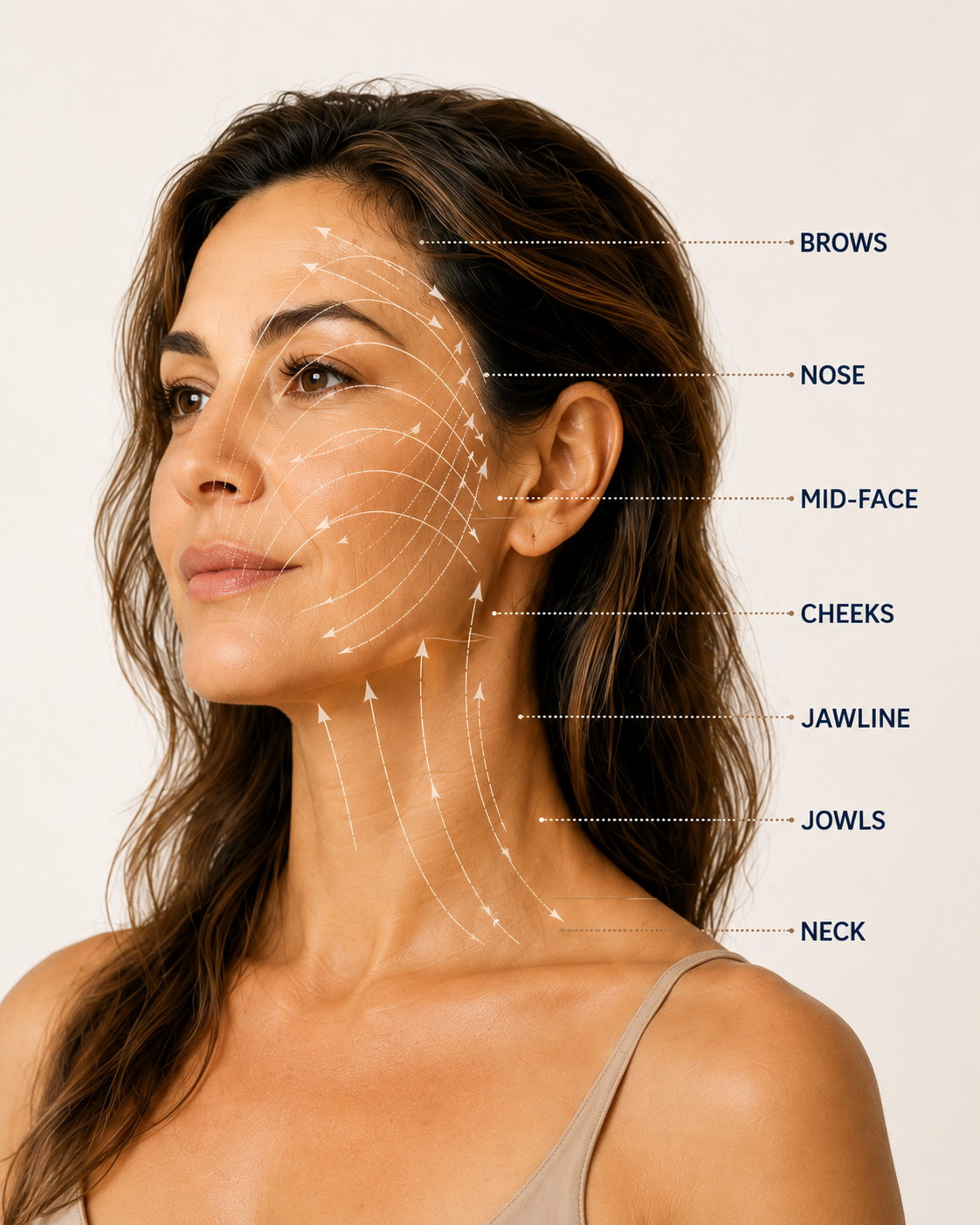
A face thread lift places medical threads beneath the skin to support selected soft tissues and may create changes in facial contour. People often research the procedure when they notice mild to moderate laxity or reduced definition around the midface, lower face, jawline, jowls, neck, brow or nose.
It is less invasive than facelift surgery, but it is not risk-free or permanent. Suitability, recovery and possible outcomes vary. Géniale provides doctor-led consultations for men and women considering cosmetic medicine and surgery.
Key takeaways
- Threads provide temporary support beneath the skin.
- Possible changes depend on anatomy, technique and healing.
- A thread lift cannot reproduce facelift surgery.
- Individual medical assessment is required.
What is a face thread lift?
Fine medical threads are introduced through small entry points and positioned beneath the skin. Depending on the clinical plan, they may be placed in the cheeks, midface, lower face, jawline, brow, neck or nose to support selected tissue.
What does a face thread lift involve?
The practitioner assesses facial anatomy, tissue quality, medical history, expectations and risk factors before planning the treatment area, thread type and direction. Technique should be selected for the individual rather than applied as a standard formula.
What types of threads are used?
Materials may include polydioxanone, poly-L-lactic acid or polycaprolactone. A PDO thread lift is one commonly searched option, but thread selection depends on anatomy, treatment area and the clinical plan. No material or brand is suitable for everyone.
Is a face thread lift the same as a facelift?
No. A facelift uses surgical incisions and tissue repositioning, with skin removal or redraping where appropriate. A thread lift uses small entry points and temporary threads. Recovery is generally shorter, but possible changes are more limited and less durable.
How does a face thread lift work?
Some threads engage soft tissue mechanically and provide support after placement. The body also develops a healing response around absorbable material. Published literature discusses both effects, although the amount and duration of visible change vary and long-term evidence remains limited.
Why do outcomes vary between individuals?
Skin thickness, elasticity, facial anatomy, tissue weight, degree of laxity, thread type, technique, healing, ageing and lifestyle can all influence the outcome.
Who may be suitable for a face thread lift?
Thread lifting may be discussed with selected adults who have mild to moderate laxity or contour concerns and understand that outcomes are temporary. Suitability cannot be determined from general information or photographs alone.
What concerns may be discussed?
Consultation may cover reduced definition or laxity around the midface, lower face, jawline, jowls, neck, brow or nose. Significant skin excess, heavier tissues or expectations requiring larger structural change may lead to discussion of other options.
What factors are considered during assessment?
Assessment may include anatomy, skin and tissue quality, asymmetry, medical history, medicines, smoking, previous procedures, healing risks and expectations. Another non-surgical treatment, surgical assessment or no treatment may be more appropriate.
Why is an individual consultation important?
Consultation allows the practitioner to explain risks, recovery, limitations, alternatives and likely variability in the context of the individual.
What possible changes may occur after a face thread lift?
Some suitable patients may notice tissue support or contour change in the treated area. The immediate appearance can be affected by swelling, tightness, dimpling or asymmetry and may differ after tissues settle. No specific outcome can be guaranteed.
How long do face thread lift results typically last?
Age, skin quality, laxity, treatment area, thread characteristics, healing, lifestyle and follow-up advice may influence duration.
What can a thread lift not achieve?
It cannot remove substantial excess skin, surgically reshape deeper structures or reproduce the degree and longevity of a facelift. Other treatments or surgical assessment may be more appropriate for some patients.
Face thread lift recovery
Recovery varies with the treatment area, number and type of threads, technique, medical factors and healing. Patients should follow instructions provided by their treating practitioner.
What may happen immediately after treatment?
Temporary swelling, bruising, tenderness, tightness, discomfort, dimpling, irregularity, numbness or asymmetry may occur. Entry points may also remain visible for a period.
How long is thread lift recovery?
Return to work, exercise and other activities depends on the procedure and the individual.
When should you seek medical advice?
Seek review for worsening pain, increasing redness or swelling, fever, discharge, unusual skin colour, a protruding thread, significant asymmetry, weakness, altered sensation or another severe or unexpected symptom.
Risks and considerations of a face thread lift
What factors can affect risk?
Anatomy, medical history, medicines, smoking, previous procedures, thread selection, technique, infection control, aftercare and healing may affect risk.
What are the limitations of a thread lift?
Thread lifting offers limited, temporary change and cannot guarantee symmetry or a particular aesthetic outcome. Further review or management may be required.
How much does a face thread lift cost in Australia?
There is no universal thread lift cost. Fees vary with the treatment area, number and type of threads, complexity, technique, practitioner, follow-up and treatment plan. A quote should follow assessment.
Face thread lift vs other facial rejuvenation options
| Consideration | Face thread lift | Surgical facelift | Other non-surgical options |
|---|---|---|---|
| Approach | Threads beneath the skin | Surgical incisions and tissue repositioning | Varies by treatment |
| Degree of change | Limited and temporary | Can address greater structural change | Depends on the modality |
| Recovery | Usually shorter than surgery but variable | Longer and procedure-specific | Varies widely |
| Suitability | Medical assessment required | Surgical consultation required | Depends on the concern and risk profile |
What does “non-surgical facelift” mean?
Non-surgical facelift is a broad search term, not one procedure. It may describe thread lifts, energy-based treatments or other approaches that work differently and are not equivalent to facelift surgery.
Choosing a face thread lift provider in Australia
Look for clear practitioner qualifications, individual assessment, balanced discussion of risks and limitations, transparent fees, appropriate follow-up and no pressure or guaranteed-result claims.
Frequently asked questions about face thread lifts
What is a face thread lift?
It places medical threads beneath the skin to provide temporary support to selected facial tissues.
What is a non-surgical thread lift procedure?
It is less invasive than facelift surgery but still involves threads beneath the skin and carries risks.
How long do face thread lift results typically last?
Effects are temporary. Duration varies with anatomy, thread type, treatment area, healing and lifestyle.
How much does a face thread lift typically cost in Australia?
Cost varies with treatment area, thread number and type, complexity and the individual plan.
Are thread lifts painful?
Pressure, pulling, stinging or discomfort may occur. Comfort measures can be discussed where appropriate.
What are the common risks?
Bruising, swelling, tenderness, dimpling and asymmetry can occur, as can infection, visible threads or an unsatisfactory outcome.
What are the best thread-lift products?
There is no universally best product. Selection depends on thread characteristics, anatomy and clinical planning.
Which clinics offer face thread lift consultations near me?
Choose a clinic that identifies the practitioner, assesses suitability, explains risks and provides follow-up. Géniale offers consultations in Sydney, Melbourne and the Gold Coast.
Medical references and further reading
Discuss your concerns with Géniale
Géniale provides doctor-led consultations for men and women considering cosmetic medicine and surgery. Suitability, risks, recovery, limitations and alternatives are discussed before treatment is recommended.

