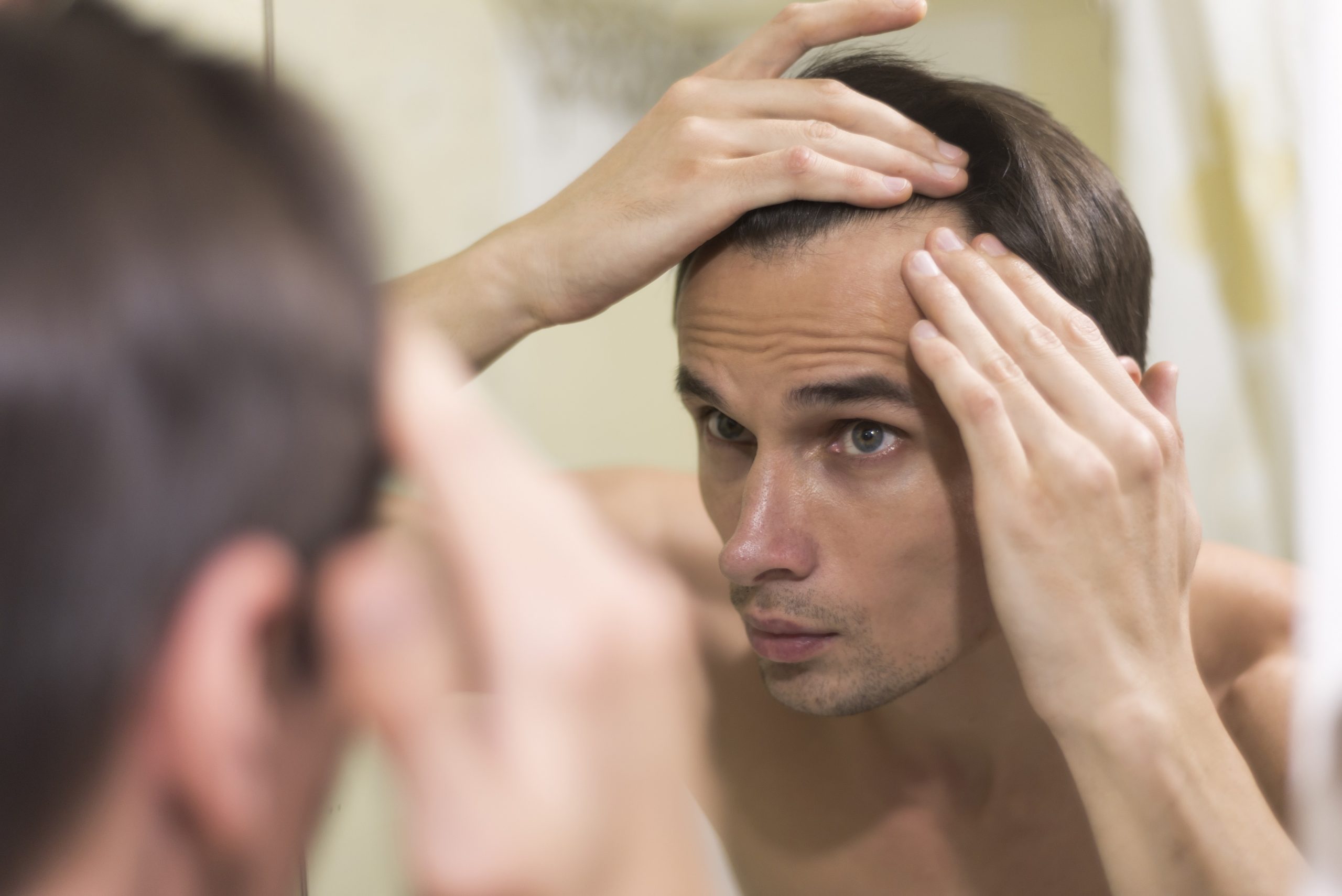
Gradual thinning
A slowly widening part, reduced density or increasing scalp visibility can develop over time.

Hair changes can feel personal. Understanding what is changing and why is the first step toward a considered plan.
At Géniale, hair restoration begins with medical assessment rather than a predetermined treatment. Dr Mike Shenouda considers the pattern and history of hair change, relevant health factors and whether further assessment, investigation, monitoring or referral may be appropriate.
Hair loss is not one condition, and the same visible concern can have different underlying explanations.
Hair thinning or shedding may relate to hereditary pattern hair loss, changes in the hair-growth cycle, hormonal change, illness, significant physical or emotional stress, nutritional factors, some medicines, scalp conditions or other medical causes. More than one factor may be present at the same time.
That is why a consultation should begin with your history and pattern of change rather than an assumption about which treatment you need.
A slowly widening part, reduced density or increasing scalp visibility can develop over time.
More hair in the shower, brush or on clothing may represent a change in the normal hair-growth cycle and deserves context.
Recession around the temples or frontal hairline can be part of a pattern that should be assessed individually.
Distinct patches are not the same as typical gradual pattern thinning and may require a different diagnostic pathway.
Redness, scaling, inflammation, pain or persistent itch can be clinically relevant and may change the appropriate next step.
Illness, surgery, childbirth, sudden weight change or significant stress can sometimes precede increased shedding.
When assessing hair loss, it can be useful to consider the overall pattern rather than focusing on a single area. Clinical assessment may consider hair density, hair calibre, distribution, the scalp, the timing of shedding and whether the pattern suggests a particular cause.
The aim is not to promise regrowth. It is to understand what may be contributing to the change, what can reasonably be assessed, and which management pathways may or may not be appropriate for you.
A useful consultation asks: Is this expected pattern hair loss, a temporary change in the hair cycle, a scalp problem, a medical issue, or a combination?
Women may notice a widening part, reduced density through the crown, increased shedding or a more general change in hair volume. Hormonal transitions, including menopause, may be relevant for some patients, but they are not the only possible explanation.
A consultation can consider the timing of the change, menstrual or menopausal history where relevant, recent illness or stress, nutrition, family history, medicines, scalp symptoms and previous hair-loss management. Further medical investigation or referral may be appropriate in some cases.
Male pattern hair loss is common and may involve the frontal hairline, temples or crown. However, not every change in a man's hair is simply hereditary pattern loss.
Rapid or widespread shedding, patchy loss, scalp inflammation, scaling, discomfort or an unusual pattern may require broader assessment before cosmetic hair-restoration options are considered.
A consultation-led treatment helps separate the concern you can see from the factors that may be contributing to it.
Discuss when the change began, how it has progressed, what you are noticing and what matters to you.
Review the pattern of hair change, relevant medical and family history, scalp symptoms and previous management.
Depending on the presentation, further examination, investigations or referral may be recommended before a treatment plan is considered.
Where treatment is appropriate, discuss realistic objectives, limitations, risks, alternatives, follow-up and how progress may be reviewed.
Different types of hair loss can require different approaches. A treatment that may be considered for one pattern of hair loss may be unsuitable or irrelevant for another.
Medical assessment is particularly important when hair loss is sudden, rapid, patchy, associated with scalp redness, scaling, pain or inflammation, or occurs with other unexplained health changes. Where the presentation falls outside the appropriate scope of the Géniale hair-restoration pathway, referral to a GP, dermatologist or other practitioner may be recommended.
This is an important part of responsible hair-restoration care: sometimes the correct next step is investigation, monitoring or referral rather than a cosmetic procedure.
When thinning or shedding started, whether it is stable or changing, and the areas affected.
Relevant medical history, family pattern, hormonal or life-stage factors, recent health events and other possible contributors.
An in-person examination may be recommended to assess the scalp and pattern more closely. Baseline clinical photography may be used where appropriate and with consent.
What you have already tried, what changed, and any concerns or adverse effects you experienced.
Additional medical assessment, pathology or specialist referral may be discussed where clinically indicated.
If a treatment pathway is appropriate, available options, limitations, potential risks, alternatives, likely follow-up and fees can be discussed privately after assessment.
Dr Mike is an Australian medical practitioner and founder of Géniale and Géniale Intimate, with more than 30 years™ medical experience.
For the Géniale hair-restoration treatment, Dr Mike's role is to assess the individual pattern of hair loss or thinning, consider relevant medical factors and discuss whether investigation, monitoring, referral or a hair-restoration management pathway may be appropriate.
Where treatment is being considered, the discussion includes suitability, realistic expectations, limitations, potential risks, alternatives and follow-up.
AHPRA Registration: MED0001162043

No. The potential for hair density or regrowth to change depends on the cause of the hair loss, how long it has been present, the condition of the follicles and other individual factors.
Some types of shedding may improve when a trigger resolves. Some forms of hair loss can be progressive. Other forms can lead to permanent loss. Even where treatment is appropriate, response varies between individuals and a particular degree of regrowth or density cannot be guaranteed.
A responsible consultation should help you understand what is known, what remains uncertain and what a realistic objective may be for your situation.
Consider medical assessment if you are concerned about hair loss or thinning, particularly if the change is substantial, sudden, occurring in clumps or patches, or accompanied by scalp symptoms or other unexplained changes in your health.
A telehealth consultation can be an initial opportunity to discuss your concerns and history. An in-person scalp examination, further investigation or referral may still be required before any treatment recommendation is made.
Sydney | Melbourne | Gold Coast | Telehealth
Hair thinning can have many causes. These may include hereditary pattern hair loss, hormonal changes, illness, physical or emotional stress, nutritional factors, some medicines, scalp conditions and changes in the normal hair-growth cycle. Assessment can help determine which factors may be relevant to you.
Increased shedding can sometimes follow a physical or psychological trigger, and the change may become noticeable some time after the event. Illness, surgery, childbirth, sudden weight loss, nutritional deficiency, significant stress and changes in some medicines are among the possible contributors. Sudden or substantial shedding should be discussed with a medical practitioner.
Hair changes can occur around menopause and hormonal transition, but menopause is not the only possible cause of thinning. Family history, general health, nutrition, medicines, scalp conditions and other factors may also be relevant, so individual assessment is important.
No. Hereditary male pattern hair loss is common, but men can also experience other forms of hair loss and shedding. An unusual pattern, rapid change, patches, scalp inflammation or other symptoms may warrant broader medical assessment.
Significant physical or psychological stress can be associated with a temporary change in the hair-growth cycle in some people. Because there are many possible causes of shedding, persistent or concerning hair loss should not automatically be attributed to stress without assessment.
Not everyone needs pathology testing. Depending on your history, examination and pattern of hair loss, a medical practitioner may recommend investigations to explore possible contributing health factors.
It is not possible to promise restoration of previous density. The potential for improvement depends on the cause, duration and pattern of hair loss, follicle status and individual response. Some forms of hair loss may improve, some may fluctuate or progress, and some can be permanent.
There is no single timeline that applies to every patient. Hair grows in cycles, different causes of hair loss behave differently, and any management plan may require monitoring over time. Your expected review pathway should be discussed after assessment.
Early assessment can be useful when you are concerned about a change, but assessment does not mean treatment is automatically required. The appropriate next step may be observation, investigation, referral or discussion of management options depending on the cause and your circumstances.
Yes, a telehealth consultation can be used for an initial discussion of your concerns, history and possible next steps. Hair and scalp assessment may require an in-person examination before a diagnosis or treatment recommendation can be made.
Medical reviewer: Dr Mike Shenouda, Medical Practitioner | Cosmetic Physician | AHPRA MED0001162043
Page reviewed: 3 September 2026
General information: This webpage provides general information and is not a substitute for individual medical advice, diagnosis or treatment. Hair loss and hair thinning have multiple possible causes. Suitability for any investigation or treatment is assessed individually. Where treatment is considered, expected benefits, limitations, potential risks, alternatives, follow-up and costs should be discussed as part of informed consent. Outcomes vary and no particular degree of hair regrowth or density can be guaranteed.
Complimentary telehealth consultation: Available for this Géniale consultation pathway as an initial discussion. Telehealth may not be sufficient to assess the scalp or establish the cause of hair loss. An in-person medical consultation, investigation or referral may be recommended and may involve fees. Contact Géniale for current details.

